
As one sails farther into the sea of one’s “golden years” one is called upon to reminisce about some of the milestones that mark certain events in our lives. So it was with me, as I spoke with a friend the other day who also happened to be in the U.S. Navy about the same time I was, in the latter half of the 1960’s.
I found myself thinking back to a particular Monday in June 1965, having just finished my first day at Naval Officer Candidate School in Newport, R.I., basically a “boot camp” for aspiring young men who wanted to join the fleet as officers. This was during the height of the Vietnam War, when the build up of the armed forces was cresting and the draft was still in effect. Here I was, a wide-eyed neophyte college grad who, just three days prior, had been living in the insouciant atmosphere of a fraternity house, now trying feverishly to adjust to a fiercely regimented existence in which every minute of the day was accountable. I still remember lying in my bunk, feeling defeated after that first hectic day Uncle Sam stole my soul, fighting back tears and cursing my mother for having given me birth. But I survived that day, and the next 18 weeks as well, to be commissioned an Ensign the following October.
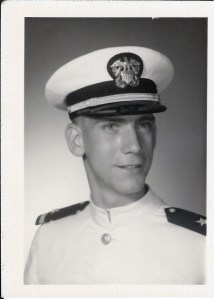
The Ensign formerly known as Officer Candidate Hood
OCS was a nearly insurmountable combination of classroom time, physical training and parade ground drilling. Class time was devoted to learning such skills as Navigation, Naval Strategy and Operations, Military Organization and one of my favorites, Military Tradition. We used to fondly refer to this as “knife and fork school” since it dealt with military bearing and conducting ourselves in a manner befitting an officer and a gentleman. As you might expect, there were myriad forms to fill out, including next of kin and an insurance policy. I’ll never forget how first sentence of the insurance booklet read, “Even Ensigns die!” Welcome to the military.
Of course, indoctrination to naval terms was a big part of our education. We needed to be able to recite the military alphabet phonetically and identify each signal flag representing that letter (or number). Each letter of the alphabet was pronounced using a word, e.g., Alpha for “A” or November for “N” to avoid any confusion over a radio transmission. This was the military now and you had to watch your Papa’s and Québec’s! I was assigned to Oscar company for the duration. That was the easy part. The most difficult was to learn a whole new nautical language. You don’t enter a ship, you board it; it’s not the entrance, it’s the Quarterdeck; it’s not a floor, it’s a deck; it’s not a stairway, it’s a ladder; not a wall, a bulkhead; not a hallway, but a passageway; not a ceiling, an overhead; not a bed, a bunk; not a door, a hatch; not a window, a porthole; not left, but port; not right, but starboard; not down there, but below decks; not up there, but topside; not front or back, but forward and aft; not beside you, but abeam of you; not the middle, but amidships; not a room, but a space; not a kitchen, but a galley; not a dining room, but a mess hall. And woe betide the sailor who referred to the front or back of the ship, for he might end up being keel-hauled from the bow to the stern! And it didn’t matter if you were actually on a ship or not, those were the terms you always used.

Can you find my company flag?
And we had to learn to tell time all over again. Military time is based on the international 24 hour clock, so 7am was known as 0700 hours and 9pm was 2100 hours, etc. Zulu time or the prime meridian, the time line located through Greenwich, England was used when discussing rendezvous times so that everyone knew exactly what time was meant no matter where they were in the world. If a widespread operation was to commence at 800 hours Zulu, each command could convert that to their particular local time.
For one week, each OC (Officer Candidate) had to be in charge of his company based on what the POD (Plan of the Day) required. He had to assemble and lead his company to classes, drills, assemblies and chow. You had to have them marching with precision and correctly attired to each event or else face the wrath of some passing staff officer who would assign extra weekend drill time to your company if he saw the need. One of the more surreal moments was chow time. I would march my company up to the senior OC in charge of the mess hall that day and shout out my request, “Officer Candidate Hood, respectfully requesting messing instructions for myself and 17 officer candidates, Sir!” The response was something like, “very well, Mr. Hood, mess yourself and 17 officer candidates in chow hall B, on the double!” As I said, military bearing was everything.
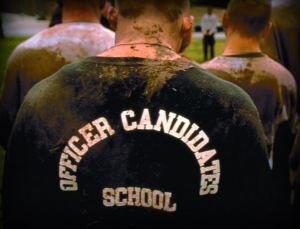
OK, guys, get this mess cleaned up so we can go to mess.
All this, plus standing watches. It was as if our barracks was a ship at sea. You had to stand your share of watches. On a ship you have your primary job and you stand watches as well. This was no different. Of course the worst was the mid-watch from midnight to 0400 hours. After a day of classes, obstacle course and assemblies, you had to walk the passageways of the barracks, check in at various “watch stations” and keep an extremely accurate log of all this. Falling asleep on watch is a very severe offense in the military, punishable by death in certain circumstances. I actually fell asleep while walking on one particular mid-watch. I walked right into a bulkhead which, quite naturally, woke me up. I told no one about this. This practice at sleepless nights paid off, as I was later to find out at sea.
I had one harrowing experience that almost changed my life. On one occasion there was a mix-up on when the six man “section” of Oscar company that I belonged to was to report for a special meeting. We missed our appointed time. Our company commander was so incensed over it he demanded that the entire section be “washed out” and sent to the fleet as enlisted personnel. Unauthorized Absence, or UA, is a serious offense. However, thanks to the more level-headed Executive Officer of the base, the Base Commander was convinced we were not at fault and dismissed the charges. A close call that would have definitely affected the course of my life.
For the first month, we were not allowed off base. After 4 weeks we were permitted to go into town from Saturday after 12oo hours until Sunday evening at 1800 hours, but wearing our OC uniforms. Newport, R.I. is a charming, quaint seaside town with all the markings of a Herman Melville novel. Many of the local watering holes were awash with girls, whom we referred to as the Fall River Debutantes. Fall River, Massachusetts was only a half hour drive away and many of the young working girls would come down hoping to drop anchor on an OC. Yes, it was much like you saw in the movie “An Officer and a Gentleman”, with one exception, no one ever suggested I looked like Richard Gere.
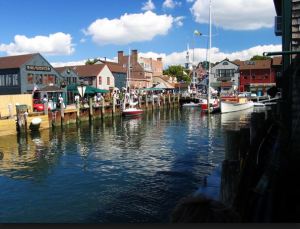
A typical scene in Newport, R.I.
So, anyway, I made it through. The big moment just before graduation and being commissioned was finding out what your first fleet assignment was going to be. You put in three requested duty stations in the order you wanted them. I had requested destroyer duty first, but you never knew what you might get. So what do you think? What would be the destiny of this slacker college boy turned ultimate warrior in 18 short weeks? See Part Two installment to find out……
 The Cvillean